Virtual Credit Cards for Google & Facebook Ads: How to Pay with Crypto Anonymously

The Media Buyer's Nightmare: Payment Flags and Suspensions
Digital marketing in 2026 is a game of scale, speed, and resilience. For affiliate marketers, drop-shippers, and digital agencies, managing ad spend is one of the most critical operational pillars of business. Yet, it is also one of the most fragile. If you have ever run paid traffic campaigns on Google Ads, Facebook Ads (Meta Ads), or TikTok Ads, you are likely familiar with the dreaded notification: "Account Suspended due to Suspicious Payment Activity" or "Billing Details Mismatch."
These advertising platforms employ hyper-sensitive, automated compliance algorithms designed to combat credit card fraud and regional evasion. However, these automated systems often sweep up legitimate business owners who are simply trying to run their ads. When an agency scales by running multiple ad accounts for different clients, using the same credit card across these accounts is an open invitation for a chain suspension. Once one account gets flagged for a minor policy violation, every other account associated with that payment method is blacklisted as well.
To survive and keep their campaigns running, media buyers have turned to Virtual Credit Cards (VCCs). But traditional VCC providers are heavily centralized, requiring rigorous credit history checks, corporate verification, and lengthy onboarding processes. This is why modern advertisers are switching to anonymous, crypto-funded virtual cards. In this guide, we will explore how you can use crypto to fund your ad campaigns anonymously and secure your ad accounts from unexpected bans.
Why Ad Platforms Flag Traditional Credit Cards
The core of the payment problem lies in how ad networks verify payment methods. When you link a credit card to Google Ads or Meta Ads, the platform performs a series of automated background checks:
- Card BIN Matching: The Bank Identification Number (BIN) tells the platform whether the card is a prepaid, debit, or credit card, and which bank issued it. Ad platforms prefer corporate credit cards and often reject prepaid or low-quality virtual cards automatically because they are associated with high chargeback rates.
- Address Verification System (AVS): The billing address you enter in your ad manager must match the address registered with your bank. If you are running international campaigns or using a card from a different country, the system flags the transaction as suspicious.
- Associated Account Linking: If you use a single bank card on three different Facebook ad accounts, and one account gets suspended for any reason, the other two accounts will likely be shut down shortly after because they share the same payment fingerprint.
Using a dedicated virtual card for each individual ad account resolves this issue. By isolating your payment methods, you prevent a single suspension from causing a domino effect across your entire agency. If one card gets flagged, your other campaigns remain active and unaffected.
The Rise of Crypto-Funded Virtual Cards for Advertisers
Crypto-funded virtual cards have emerged as the ultimate tool for media buyers. Instead of linking your business bank account to a card issuer, you top up your cards using stablecoins like USDT or USDC. This approach offers several operational advantages for scaling agencies:
- Instant Card Creation: Agencies can generate dozens of cards on demand as they launch new campaigns or onboard new clients. There is no need to wait weeks for physical cards to arrive.
- Anonymity and Isolation: Cards do not carry your personal name or credit history, preventing ad networks from linking your accounts back to your personal identity. This is crucial for privacy-minded marketers.
- Global Accessibility: Marketers can manage campaigns and fund cards from anywhere in the world without being restricted by local banking regulations, capital controls, or credit limits.
- Cost Control: You can assign a specific balance to each virtual card. This ensures that an ad platform cannot overcharge you or drain your main bank account due to billing bugs or runaway campaign spends.
Introducing AnomaCard: The Ultimate VCC for Ad Spend
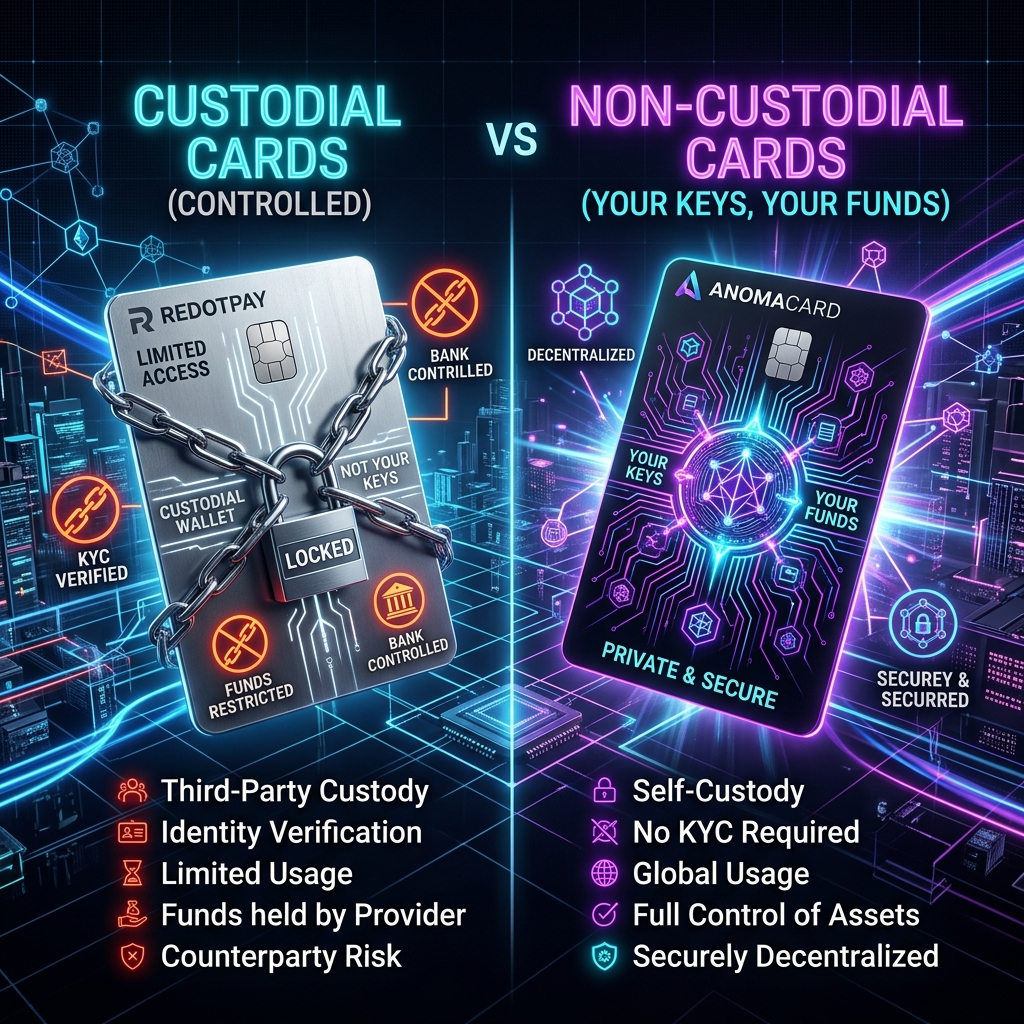
AnomaCard is designed specifically to bridge the gap between Web3 financial freedom and Web2 ad platforms. Operating under a non-custodial framework, it allows digital marketers to generate high-quality virtual Visa and Mastercard debit cards directly from their self-custody wallets.
Unlike traditional corporate card issuers, AnomaCard does not require credit checks, bank statements, or invasive KYC procedures. Marketers can maintain complete privacy. Because AnomaCard uses premium business-tier BINs, the cards are widely accepted by Google Ads, Facebook Ads, TikTok Ads, and major SaaS tools, minimizing the risk of automated payment flags. You can buy Facebook Ads credit with crypto safely and maintain continuity.
How to Use AnomaCard for Google & Facebook Ads: A Step-by-Step Guide
Setting up and funding your virtual cards with AnomaCard is simple and takes less than two minutes. Here is the step-by-step process:
- Connect Your Wallet: Visit the official AnomaCard site. Connect your preferred Web3 wallet (such as MetaMask, Rabby, Ledger, or Trezor). There is no registration form, email verification, or username requirement.
- Fund with Stablecoins: Select the stablecoin you want to use (USDT or USDC) and the network. AnomaCard supports low-fee networks like Arbitrum, Solana, and BSC, allowing you to fund your card with minimal gas fees and avoid Ethereum network congestion.
- Create Your Virtual Card: Specify the amount you want to load onto the card. Once the transaction is confirmed on-chain, your virtual card is generated instantly with a unique card number, expiry date, and CVV code.
- Link to Your Ad Manager: Add the virtual card details to your Google Ads or Facebook Ads account. Use any billing address that matches the country of your ad account, as AnomaCard supports flexible AVS matching to ensure smooth approvals.
Why AnomaCard is the Best VCC for Media Buying
There are several VCC providers on the market, but AnomaCard stands out as the best choice for digital agencies and affiliate marketers who require an anonymous VCC for media buying:
- No KYC/KYB Barriers: Traditional providers require business registration documents (KYB) and personal ID scans. AnomaCard values your privacy and requires zero personal documents. You can spin up virtual cards instantly.
- Premium Business BINs: Ad networks automatically trust business BINs, resulting in higher approval rates and fewer suspicious activity flags compared to cheap consumer cards.
- Real-Time Fiat Conversion: Your crypto remains in your control until a transaction is made, meaning you do not have to pre-convert large amounts of crypto to fiat and leave it in a custodial account.
- Fee Efficiency: AnomaCard features a lifetime VIP fee system. As you accumulate volume across your campaigns, your top-up fees drop from 0.60% down to 0.30%, which is significantly cheaper than traditional cross-border bank fees.
- Multi-Wallet Support: You can connect different wallets for different team members or clients, maintaining clean bookkeeping and separation of funds.
Conclusion: Protect Your Ads and Scale Without Limits
In the fast-paced world of digital advertising, payment reliability is the foundation of your business. Do not let bank card mismatches or strict compliance algorithms shut down your campaigns and destroy your revenue. By switching to AnomaCard's anonymous, self-custodial virtual cards, you can secure your media buying pipeline, protect your personal banking details, and scale your agency without boundaries. Start spending crypto directly on your ad campaigns today.
Ready to take control of your financial privacy?
Order Your Anonymous Card NowAnomaCard Protocol
Verified ResearchPublished by the AnomaCard Research Protocol. Focused on decentralized financial privacy, self-custodial architecture, and zero-KYC payment solutions.