How to Spend Monero (XMR) with a Virtual Visa & Apple Pay Without CEX KYC (2026)
Monero (XMR) is the gold standard of digital cash: private, untraceable, fungible, and surveillance-resistant. By default, transactions on the Monero blockchain conceal the sender, recipient, and amount using RingCT, stealth addresses, and Bulletproofs. Yet Monero holders face an everyday paradox: how do you spend XMR in stores, restaurants, and online when payment terminals only accept Visa and Mastercard?
Between 2024 and 2026, regulatory pressures accelerated. Under the EU's MiCA framework, the FATF Travel Rule, and US Treasury enforcement, major exchanges—including Binance, Kraken, and OKX—delisted Monero. Depositing XMR onto a regulated platform now triggers compliance flags, account freezes, or identity demands. Centralized off-ramps are no longer viable for privacy advocates.
Fortunately, decentralized finance provides a sovereign alternative. You can convert Monero into everyday purchasing power worldwide without revealing your identity, opening a bank account, or risking fund freezes. In this guide, we break down the Sovereign Monero Off-Ramp: bridging XMR into a non-custodial, zero-KYC virtual debit card compatible with Apple Pay and Google Pay.
The Monero Off-Ramp Dilemma: Why Centralized Exchanges Fail
Understanding why a sovereign bridge is required begins with examining the failure points of traditional exchange off-ramps:
First is systemic exchange delisting and account termination. Centralized exchanges operate as licensed financial institutions. Because Monero conceals transactional metadata, exchange software cannot run blockchain analytics or generate Travel Rule reports. Consequently, exchanges refuse deposits. Users attempting to deposit XMR frequently find their accounts locked with funds frozen indefinitely under compliance reviews.
Second is the deanonymization trap and personal data exposure. On the rare platforms where privacy coin trading persists, mandatory Level 2 and Level 3 KYC verifications defeat the purpose of holding Monero. Submitting passport scans, facial video biometrics, and utility bills ties private on-chain wealth directly to legal identities, creating targets for data breaches and state surveillance.
Third is banking discrimination and frozen fiat accounts. Converting Monero on an exchange to wire fiat to a traditional bank triggers anti-money laundering algorithms. European and American banks routinely block incoming crypto wires, file Suspicious Activity Reports, and terminate customer accounts without explanation.
Architecture of the Sovereign Bridge: Monero to Virtual Card
The sovereign solution bypasses traditional banking and centralized exchanges. Instead of forcing banks to accept Monero, you utilize a multi-layered pipeline: Private Wallet → Non-Custodial Cross-Chain Swap → AnomaCard Virtual Visa/Mastercard → Point-of-Sale Terminal.
Your capital originates inside your sovereign Monero wallet (Cake Wallet, Feather, or the Monero GUI). When funding real-world expenses, you execute a peer-to-peer or non-custodial swap into low-fee stablecoins (USDT or USDC on Arbitrum, Solana, or Tron). Because you use non-custodial swap aggregators or atomic swap protocols, no user accounts or KYC verifications are required.
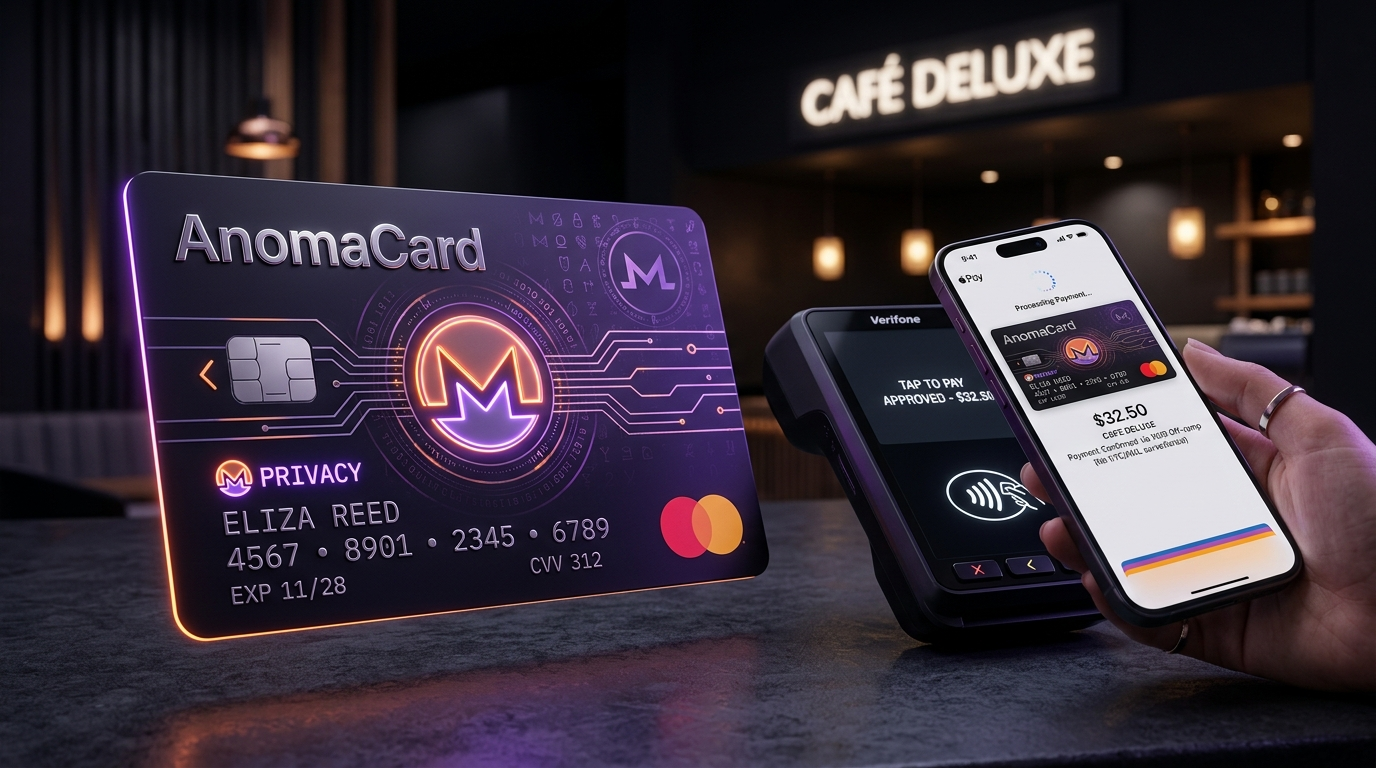
The stablecoins arrive at your AnomaCard deposit address. Within seconds, AnomaCard provisions an active virtual Visa or Mastercard preloaded with your funds. You can immediately tap and pay at over 100 million payment terminals worldwide via Apple Pay or Google Pay, or shop online with instant 3D Secure verification.
Why AnomaCard is the Ideal Spending Protocol for Monero
AnomaCard was engineered for financial sovereignty and privacy, matching the cypherpunk ethos of Monero:
1. Strict Zero-KYC Policy: AnomaCard never asks for your legal name, home address, passport, or national ID. There are no verification forms and no identity databases to compromise. You interact exclusively through your Web3 wallet address.
2. 100% Non-Custodial Security: You never deposit lifetime savings into our custody. Your primary capital remains in cold storage or your private Monero wallet. You only top up the exact balance needed for immediate purchases, eliminating counterparty risk and exchange insolvency exposure.
3. Industry-Lowest Fees (0.3% Deposit Fee): Many prepaid card providers charge 5% to 8% in hidden conversion markups. AnomaCard charges an industry-low 0.3% deposit fee with zero monthly subscription costs, keeping your purchasing power intact.
4. Instant Apple Pay and Google Pay Provisioning: Once your stablecoin deposit confirms on Arbitrum, Solana, or Tron, your virtual card details are generated. With a single tap, provision your card into Apple Wallet or Google Wallet for contactless NFC payments in grocery stores, transit hubs, flights, and restaurants globally.
Step-by-Step Tutorial: Spending Monero via AnomaCard in 5 Minutes
Follow these five simple steps to turn private Monero into global spending power:
Step 1: Secure Your Monero in a Self-Custodial Wallet
Ensure your XMR is held in a self-custodial wallet where you control the spending and view keys (e.g., Cake Wallet, Feather, or Monero GUI). For optimal network privacy, route your wallet traffic through Tor or an encrypted VPN tunnel.
Step 2: Generate an AnomaCard Virtual Card
Navigate to AnomaCard using any standard Web3 browser. Connect your decentralized wallet (MetaMask, Rabby, or Phantom) to access your dashboard. Select "Create Virtual Card". In less than 30 seconds, your virtual card profile is active with zero paperwork.
Step 3: Execute a Non-Custodial Swap (XMR to USDT on Arbitrum or Tron)
Select a trusted non-custodial exchange aggregator (such as Trocador, FixedFloat, SideShift, or an atomic swap interface). Specify Monero (XMR) as the deposit currency and select USDT on Arbitrum, Solana, or Tron as the receiving asset. Paste your AnomaCard deposit address as the recipient destination and send the XMR payment from your Monero wallet.
Step 4: Automatic Card Balance Credit
As soon as the cross-chain swap confirms on-chain (typically 1 to 3 minutes), your AnomaCard dashboard automatically credits the deposit with our standard 0.3% fee. Your card is preloaded and ready for immediate transactions.
Step 5: Add to Apple Pay / Google Pay and Spend Anywhere
Click "View Card Details" to reveal your 16-digit card number, CVV, and expiration date. Open Apple Wallet or Google Wallet on your smartphone, add the card credentials, and complete the instant verification. You can now tap your phone at any contactless payment terminal on Earth or pay online without bank interference.
Essential Privacy Best Practices for Monero Spenders
To preserve complete operational security when transitioning between private and retail rails, adhere to these technical recommendations:
Use Primary Subaddresses: When receiving funds or staging swaps, always generate fresh subaddresses (starting with the number 8) in your Monero wallet. This prevents public observers from linking your transactions together.
Clean Network Footprint: Access your wallet and the AnomaCard interface via privacy-hardened browsers (like Brave or LibreWolf) with tracking protection enabled, or run your workflow through the Tor network.
Decouple Real Identity at Checkout: Because AnomaCard virtual cards do not have a hardcoded name associated with the cardholder, enter any billing alias or pseudonym when shopping online. The transaction processes flawlessly while preserving your anonymity.
Reclaiming the Vision of Cypherpunk Digital Cash
The true vision of cryptocurrency was peer-to-peer electronic cash that allows individuals to participate in the global economy without permission, surveillance, or fear of censorship. By uniting Monero's untraceable blockchain privacy with AnomaCard's frictionless, non-custodial global payment rails, financial sovereignty is a practical, everyday reality. Spend your wealth on your own terms, wherever you are in the world.
Ready to Spend Monero Worldwide Without KYC?
Bridge your Monero into instant real-world purchasing power with AnomaCard. Get an instant non-custodial virtual Visa/Mastercard with zero identity verification, industry-low 0.3% deposit fees, and contactless Apple Pay and Google Pay integration.
Get Your Anonymous Card Now →AnomaCard Research Team
Verified ResearchPublished by the AnomaCard Research Protocol. Focused on decentralized financial privacy, self-custodial architecture, and zero-KYC payment solutions.